From Immigrant to Fashion CEO: Eve DeMartine on Rejection, Posture, and Why Confidence Comes From Action
By Kate Ziuz | Presence Coach for Founders & Entrepreneurs
When Eve DeMartine moved to the United States seventeen years ago, she knew exactly one person: her husband.
She had a business degree from the UK. Back in Malaysia, she'd been promoted almost immediately. In the US, none of that transferred. She sent out resume after resume and got rejection after rejection. Everything was new — her career, the culture, even the way she spoke.
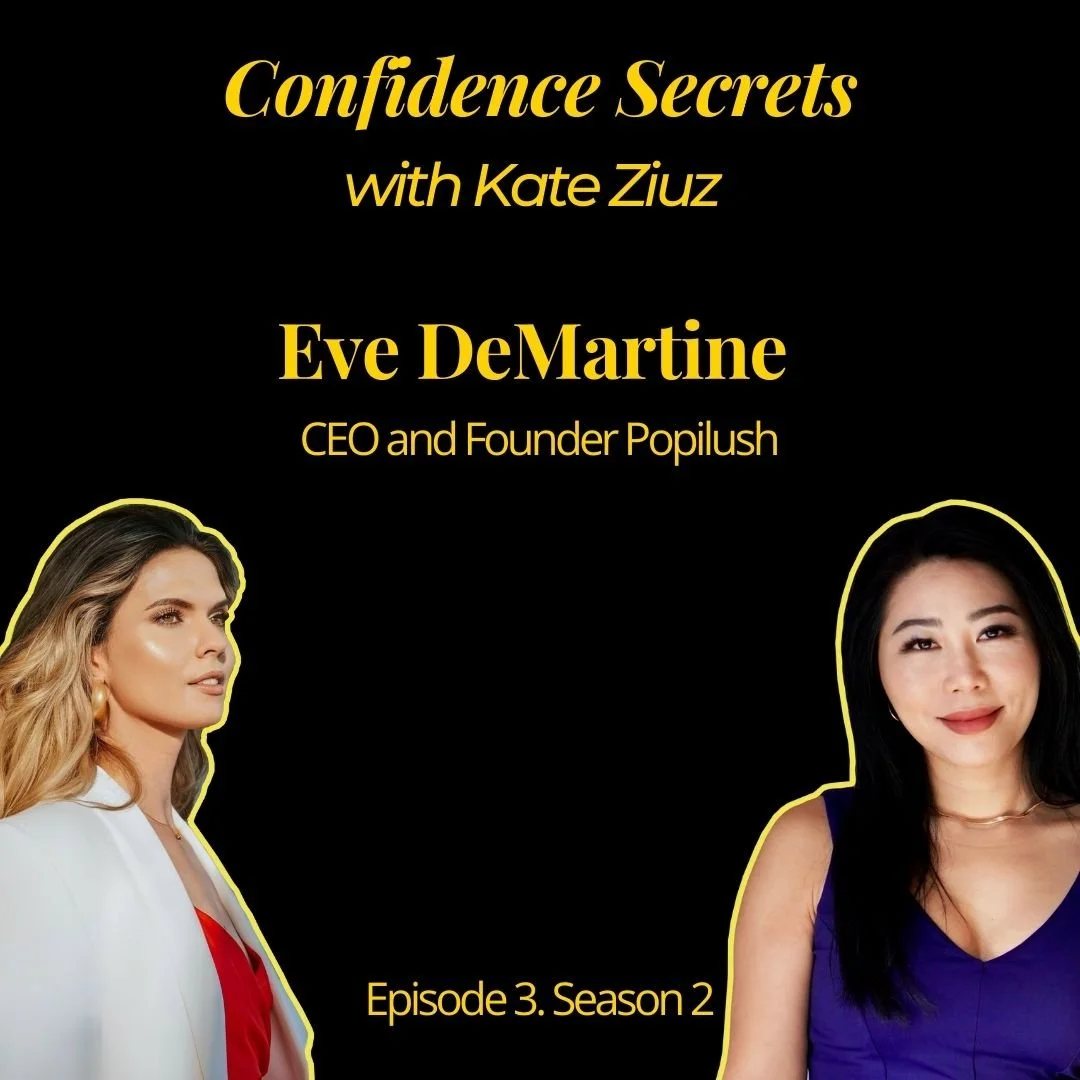
Today she's the founder of Popilush, a shapewear and fashion brand that went from launch to millions of customers in three years.
I brought Eve onto Confidence Secrets because her answer to "how did you build confidence" is the least romantic and most useful one I've heard: she didn't build it first. She acted first, and the confidence followed.
→ Watch or listen to the full episode on YouTube | Spotify | Apple Podcasts
"Rejection Is Okay. It Will Only Make Me Stronger."
Eve comes from a family of entrepreneurs, and she credits that for the one thing that got her through the early years: a refusal to interpret rejection as a verdict.
Her framing was almost mathematical. She couldn't control that she lacked the network and the local track record other candidates had. What she could control was effort. We all have the same 24 hours. If others work eight, I could work double.
And then the line I keep thinking about: confidence comes from action.
Not from preparation. Not from feeling ready. From doing the thing, getting the outcome — good or bad — and doing it again.
She told me about something that had happened the day before we recorded. A woman who spoke no English came into her office with a translator and asked for a job. Eve's reaction wasn't pity. It was admiration. That kind of courage reminded her exactly how many times she'd been rejected and kept going anyway.
As an immigrant myself — I'd been in California about five years when we recorded — that landed hard. The willingness to show up in a room where you're at a disadvantage is itself a presence skill. Most people never develop it because they wait to feel ready.
What She Does Before a Room
Eve's approach to first impressions is preparation-based, not personality-based. Before her recent product launch event, she went through the attendee list in advance and thought about what she might actually talk about with the people she'd meet.
Then she showed up and asked open-ended questions.
That's it. That's the whole method — and it works because the goal isn't to perform confidence. It's to be genuinely interested enough that the other person feels it. Her words: a strong first impression is about being prepared, approachable, and aware of how you make others feel.
I'd add one thing from the coaching side. Preparation is the most underrated presence tool there is, because it frees your attention. When you already know what you're walking into, you're not spending cognitive energy figuring out what to say — you can actually be present with the person in front of you. That's what reads as warmth and composure. It's not a trait. It's bandwidth.
Posture, and the Thing She Said That Stopped Me
When I asked about body language, Eve named four things she's always conscious of: stand tall, shoulders back, don't cross your arms, keep good eye contact.
Then she said something I didn't expect: you dance, right? So you know posture is so important.
She was correct. Before coaching, I spent years in dance — a discipline where posture, movement, and expression aren't decoration, they're the entire medium. It's part of why I teach presence the way I do, as mechanics rather than mindset. In dance, nobody tells you to feel more graceful. They correct your spine.
Eve's framing was the same: these small adjustments set the tone for how others perceive you and how you carry yourself in the space. Not how you feel. How you're read.
The Thing Speakers Forget the Second They Step Off Stage
One of the things I raised in our conversation — because I'd just seen it at an event — is what happens in the moments around the moment.
Speakers hold it together on stage. Posture up, head high, smiling. And then they walk off and immediately release everything, as though the performance ended when the mic did.
It didn't. There are photographers in the room, and they're not only shooting while you're speaking. They're getting the crowd shots, the backstage shots, the in-between. Those are the images that end up in the event recap and on someone's feed.
The fix isn't to perform constantly — it's to practice until your baseline posture is good enough that you don't have to think about it. When it's a habit rather than a performance, there's nothing to drop.
Preparation, in the Car and in the Shower
I asked Eve what preparing actually looks like for her. Her answer: she rehearses during her drive home, or in the shower.
Mine is similar — my final run-through happens in the car on the way to the event, music off, talking to myself.
What I'd pull out of this for anyone who gets told to "just practice more": practice is personal. Some people need fifty repetitions. Some need three. The point isn't hitting a number, it's getting comfortable with your own tone and voice so that when you open your mouth in the real moment, it isn't the first time you've heard yourself say it.
Eve's Three Tips
I asked what she'd tell someone struggling right now — a new immigrant, a founder starting over, anyone at the bottom of the climb.
Own your confidence. Even when you're nervous, focus on your strengths rather than your gaps. People gravitate toward those who project self-assurance, so stay positive and let that be what you lead with.
Be intentional in conversation. Speak clearly and with purpose, and listen more than you speak. Her reasoning: people remember those who make them feel heard and appreciated. (We ended up agreeing on a version of the same idea — people may not remember what you said, but they remember how you made them feel.)
Pay attention to style and energy. Wear something that makes you feel confident and suits the event, and let your personality show. Then mind the energy you bring, because it's the thing that leaves the longest impression.
On that last point she said something worth keeping: confidence is contagious — and so is the lack of it. Whatever you walk in with transfers to the room before you've said a word.

About Eve DeMartine
Eve DeMartine is the founder of Popilush, a fashion and shapewear brand built around one-piece solutions with built-in shaping. Born in Malaysia and educated in the UK, she moved to the United States seventeen years ago and started her career from scratch before launching the brand, which grew to serve millions of customers within three years.
Connect with Eve:
Website: popilush.com
Instagram: evedemartine
Instagram: popilush
The Takeaway for Founders Building Visible Brands
Eve's version of confidence isn't a feeling she found. It's a byproduct of repetition — rejections survived, rooms entered before she felt ready, practice done in the car.
That's the same thing I teach from the physical side. Presence isn't a trait you either have or don't. It's posture you've practiced, eye contact you've trained, preparation that frees your attention for the people in front of you. Mechanics, repeated, until they stop requiring thought.
If you're preparing for a moment where how you're perceived matters — a stage, a camera, a room full of people who could become clients — that's what I do.

Kate Ziuz is a presence coach for founders and entrepreneurs building visible brands. She specializes in the mechanics of on-camera presence, stage presence, and high-stakes preparation. Based in Los Angeles. Featured in Best Holistic Life Magazine, Femforce Podcast, Authority Magazine, and more.
