How to Prepare for a Remote Podcast Interview When You're Nervous on Camera
By Kate Ziuz | Presence Coach for Founders & Entrepreneurs
If you're nervous before a remote podcast interview — recording from home over Zoom, Riverside, or StreamYard — the answer isn't to calm down. It's to prepare differently.
Most people prepare their content. They know their talking points, their story, their message. And they still show up on camera looking less credible than they actually are. Not because they're nervous, exactly. Because their body is sending signals they never meant to send.
I coach founders and entrepreneurs on the mechanics of presence — specifically for high-stakes visible moments like podcast recordings, speaking gigs, and media appearances. Here's what I see, every time, and what actually fixes it.
The Real Reason Remote Podcast Interviews Feel Awkward on Camera
When I watch someone's first remote podcast recording, I'm not listening to the words. I'm watching what the body does before the words start.
I see people who are genuinely expert — knowledgeable, articulate, credible in real life — open up Zoom and immediately compress. Shoulders round forward. Chin drops slightly. Eyes start doing a low-level scan of the screen instead of landing. Hands disappear or fidget.
None of this is intentional. It's what a body does when it registers pressure — and a laptop camera, a grid of faces, and a blinking "recording" indicator are all pressure cues your nervous system picks up on before you've said a single word.
The problem isn't nerves. The problem is that your body has patterns — habitual physical responses to high-stakes situations — and those patterns read as uncertainty to everyone watching. Even if you feel composed on the inside, the camera is picking up signals that tell a different story.
This is what I call an authority leak: a specific physical pattern that undermines how credible you appear, completely separate from what you actually know.
What to Prepare Before Your Remote Podcast Recording
1. Set up your home recording space intentionally — before you sit down
Most people troubleshoot their setup five minutes before the call. That's too late for the physical piece.
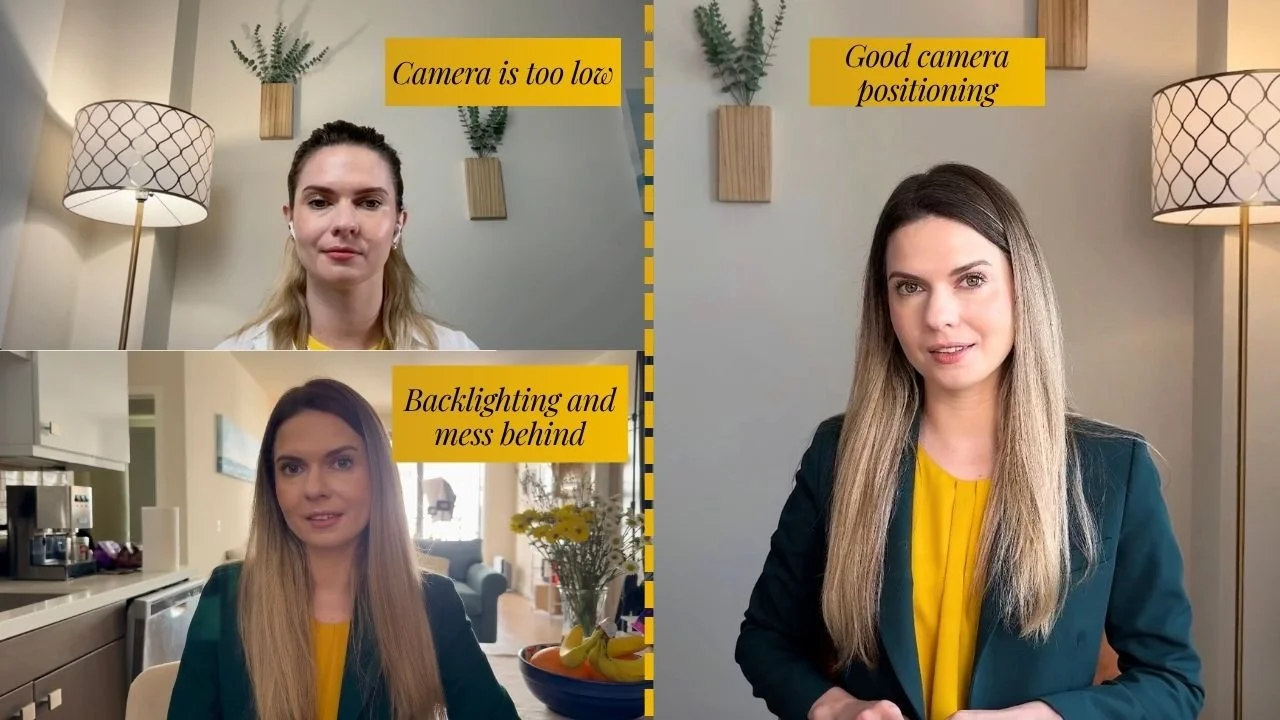
Your camera position alone changes how you read on screen. If you're on a laptop, the built-in camera sits below eye level — which means you're shooting up into your own face. It shortens your neck, compresses your frame, and creates a visual imbalance that viewers register as a lack of authority, without knowing why. Prop your laptop on books, a box, or a laptop stand until the camera is at eye level or just slightly above. If you're using an external webcam, mount or position it at the same height.
Your background should have visual depth — a wall directly behind you flattens the shot. A bookshelf, a plant, or even sitting a few feet away from the wall so there's a sense of dimension behind you all work better than a blank surface two inches from the back of your head.
Your lighting should come from in front of you. A window facing you, or a ring light positioned in front of your face, not beside or behind it. Back lighting silhouettes you. Side lighting creates shadows that make expressions harder to read. Natural light from a window in front of you is free and often better than any ring light.
2. Do a physical reset before you hit record
Not a mindset pep talk. An actual physical reset.
Stand up. Roll your shoulders back and down — not up toward your ears, but back and down, like you're trying to tuck your shoulder blades into your back pockets. Hold it for five seconds. Then sit.
This repositions your posture at the baseline so you're not starting the interview from a compressed, forward-folded position — which is exactly what happens when you've been hunched over a laptop all day before the recording. When your shoulders are back and down, your chest opens, your chin naturally lifts to neutral, and your voice has more room. You will sound different. You will look different on screen. Viewers will perceive you differently — and they won't know why, but they'll feel it.
This takes 30 seconds. Do it every single time.
3. Know where to look — and practice looking there
On a video podcast recorded over Zoom or Riverside, looking at your own face in the preview window feels like eye contact. It isn't. It reads as slightly off-gaze, and over a 30-minute conversation, that slight off-gaze accumulates into "something was a little off about her" in the viewer's mind.
Eye contact on camera means looking into the lens — the small dot at the top of your screen or webcam. Not near it, not at your host's face on the screen — into the lens itself.
This feels deeply unnatural at first, because you lose the visual feedback of seeing the other person's face react. That loss of feedback is exactly why most people avoid it and look at the screen instead. Practice it in a five-minute voice memo or Zoom test call before your recording. By the time you join the interview, it should feel mechanical enough that you can do it without thinking.
One practical tip: put a small sticky note or arrow sticker right next to your camera lens. It gives your eyes somewhere specific to go.
4. Slow down the first 90 seconds
Nerves speed up speech. This is so consistent I can identify the exact moment someone stopped being nervous in a recording — it's when the pace drops.
Fast speech signals urgency and anxiety. Slower speech signals certainty and authority. Not slow like a lullaby — measured. Like you know what you're about to say and you're not in a hurry to get it out before someone stops you.
The first 90 seconds of any remote podcast interview sets the tone for everything that follows — not just for the listener, but for your own nervous system. If you rush the opener, you'll spend the next 20 minutes trying to recover a baseline that you never established.
Practice your introduction out loud, specifically for pace. Record yourself on your phone or do a Zoom test call with yourself. If it sounds like you're trying to get through it, it's too fast.
5. Use the pre-recording small talk as a calibration window
Most people go quiet and polished the moment the host says "I'm going to hit record." Use the time before that intentionally.
On remote recordings, there's almost always a few minutes of technical check-in and small talk before the actual recording starts. That window is when your nervous system calibrates to the environment. Talk. Laugh. Let yourself be in real conversation before the "official" part begins. By the time the host hits record, your energy should already be in conversation mode — not jumping cold from silence into performance.
If you go quiet and formal the moment recording starts, listeners feel the shift, even if they can't name it. The goal is for the recorded version to sound like a continuation of the warmup, not a different person.
The Pattern Underneath All of This
Every one of these fixes addresses the same root issue: your body defaulted to its habitual response to pressure. The laptop screen, the recording indicator, the awareness of being watched — your nervous system read all of it as threat and responded accordingly. That response isn't who you are. It's a pattern. And patterns can be interrupted, replaced, and over time, overwritten entirely.
This is why podcast #3 feels different from podcast #1 for my clients. Not because they got more confident. Because they built new physical defaults — a reliable baseline they can return to every single time, on any platform, from any room in their house, without having to think about it.
One great remote recording is a moment. Five consistent recordings is authority that compounds.
If You Have a Remote Podcast Recording Coming Up
If you have a podcast interview scheduled in the next three to four weeks, Event Poise is the fastest way to walk into that recording prepared. Two sessions: one to audit your current patterns and install the mechanics, one to polish before the moment. You'll know exactly what to do with your body — and your setup — before you hit join.
Kate Ziuz is a presence coach for founders and entrepreneurs building visible brands. She specializes in the mechanics of on-camera presence, stage presence, and high-stakes preparation — helping clients close the gap between their actual expertise and how credible they appear. Based in Los Angeles. Featured in Best Holistic Life Magazine, Femforce Podcast, Authority Magazine, and more.
