Body Language for Public Speaking: How to Look Confident on Stage
By Kate Ziuz | Presence Coach for Founders & Entrepreneurs
The fastest way to look confident on stage is to stop moving so much.
Not to add gestures. Not to project harder. To be still — deliberately, visibly still — and let your voice and your eyes do the work. Stillness reads as authority because it signals that you are not in a hurry, not scanning for exits, and not managing your own nerves in real time.
That's the short answer. Below is the long one: the specific physical mechanics that determine whether an audience perceives you as authoritative, and the patterns that quietly undermine you.
I coach women leaders, founders, and entrepreneurs on exactly this — and what follows is what I actually teach, not a list of tips.
Why Most Body Language Advice Doesn't Work
You've read the lists. Make eye contact. Stand up straight. Don't fidget. Use open gestures.
All true, and almost useless — because they describe a destination without giving you a route. Don't fidget isn't an instruction; it's an observation about someone who already isn't fidgeting. Telling a nervous speaker not to fidget is like telling someone not to think about their breathing.
The reason those lists fail is that your body isn't choosing to fidget. It's running a pattern — a habitual response to pressure that was installed somewhere else and now executes automatically, without consulting you.
You can't stop a pattern by disapproving of it. You replace it by giving your body something specific to do instead. That's what mechanics means, and it's why the instructions below are physical and precise rather than aspirational.

The Five Mechanics That Determine How You're Perceived
1. Your stance: root before you speak
Before you say a word, plant. Feet roughly hip-width apart, weight even across both feet, knees soft rather than locked.
The most common stage pattern I see is weight shifting — a slow rock from one foot to the other, usually unconscious, that continues through an entire talk. To the speaker it feels like nothing. To the audience it reads as anxiety, and it drains authority continuously the whole time you're up there.
The fix isn't "stop rocking." It's feel both feet. Actively notice pressure through both heels and the balls of both feet. You can't shift your weight and stay aware of even pressure at the same time — the awareness itself interrupts the pattern.
When you move, move with purpose. Walk deliberately to a new spot, plant, and speak from there. Motion between ideas is fine. Motion during ideas is noise.
2. Your shoulders: back and down, not up
Roll your shoulders back and down — back, and down, as if you're tucking your shoulder blades into your back pockets. Not lifted toward your ears, which is what tension does.
This one adjustment changes three things at once: your chest opens so your voice has physical room, your chin naturally settles at neutral instead of dropping, and your frame occupies its actual size instead of compressing.
Do it before you walk on, not once you're already speaking. Standing tall isn't a look — it's a structural setup that changes how you sound.
3. Your eyes: land and hold
Eye contact on stage doesn't mean sweeping the room. Sweeping is what nervous eyes do — a continuous scan that never rests anywhere, which reads as searching rather than connecting.
Land on one person. Hold for a complete thought — a full sentence, not a fraction of one. Then move to someone else in a different part of the room and do it again.
Three to five seconds per person is roughly right. It will feel like far too long from the inside. It looks completely normal from the outside. That gap between how it feels and how it looks is true of almost every presence mechanic, which is why practicing on video matters more than practicing in your head.
4. Your hands: default to stillness
Most speakers gesture too much, not too little. When hands move constantly, the audience tracks the hands — which means their eyes are away from your face while you're delivering your most important content.
Your gestures should support your message, not compete with it. You are the focus; the gestures underline.
Give your hands a home position: resting comfortably at your sides, or lightly held at waist height. From there, gesture deliberately to mark a specific point, then return to home. The return is the part almost nobody does, and it's what separates purposeful gesture from continuous motion.
If your hands genuinely don't know what to do, holding a clicker or a small note card gives them a destination while you retrain the habit.
5. Your pace: slower than feels natural
Nerves speed up speech. This is so consistent that I can identify the moment a speaker settled just by listening for the point where the pace drops.
Fast speech signals urgency and anxiety. Measured speech signals certainty — not slow, but unhurried, like you know what you're about to say and nobody is going to stop you before you finish.
Pauses are the mechanic here. A full pause after an important sentence does two things: it gives the audience time to absorb, and it demonstrates that you're comfortable enough to allow silence. Nervous speakers fill every gap. Confident-reading speakers let gaps sit.
Practice your opening specifically for pace. The first ninety seconds set the baseline for everything after — rush the opener and you'll spend twenty minutes trying to recover a footing you never established.
The Body Language Mistakes Speakers Make Most Often
In order of how frequently I see them:
Rocking or weight-shifting. Continuous, unconscious, and read by every person watching as nervousness.
Pacing. Especially common in former teachers and trainers, whose bodies learned that movement holds attention. In a classroom it works. On a stage it reads as restlessness.
Over-gesturing. Hands in constant motion, pulling focus from the face.
Scanning instead of landing. Eyes that never rest, so no one in the audience feels addressed.
Upspeak. Statements delivered with a rising inflection that turns them into questions, undermining the certainty of the content.
Trailing volume. Sentences that start strong and lose energy by the end, so the most important part of each thought is the quietest.
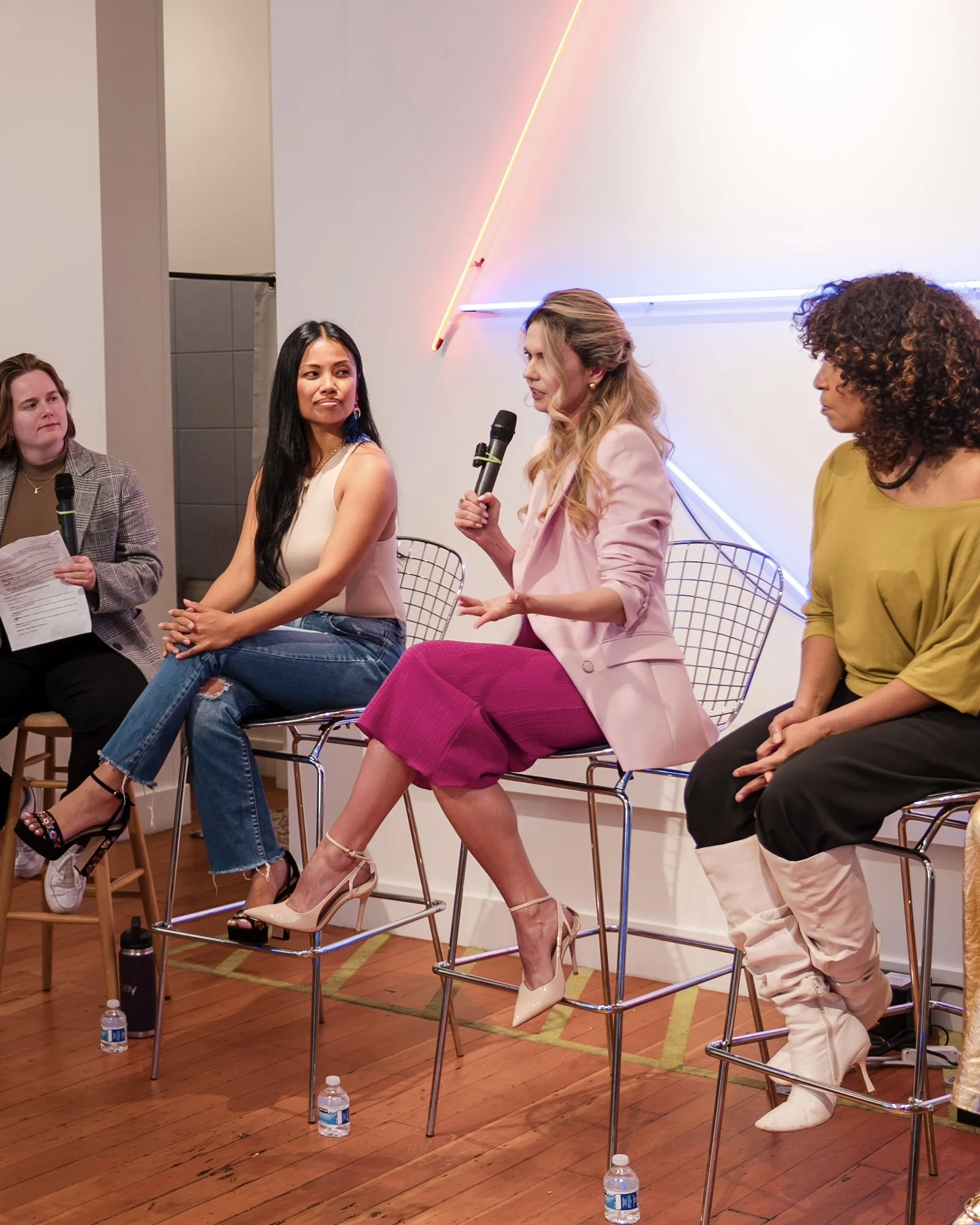
Dropping presence when you're not speaking. On panels especially — speakers hold their posture while talking, then visibly release the moment attention shifts. The audience notices. So do the photographers.
Self-touching. Hair, jewelry, face, sleeves. Small self-soothing gestures that broadcast discomfort.
None of these are character flaws. Every one is a pattern, and every pattern is replaceable.
Stage Presence Tips for Women Specifically
There's a pattern I see far more often in women than in men, and it deserves naming: compression.
Shoulders folding forward. Chin tucking down. Body angled slightly away from the audience rather than squared to it. Voice softening toward the end of statements. Physically taking up less room than you're entitled to.
It isn't a confidence deficit. It's an adaptation — a learned physical response to years in environments where taking up space felt strategically unwise. It made sense once. It follows you onto stages where it no longer serves you.

The counter-mechanics are specific:
Square to your audience. Shoulders and hips facing them directly, not angled off.
Claim your footprint. Feet at hip width, not narrower. A narrow stance physically shrinks your silhouette.
End statements as statements. Practice landing your final word with the pitch going down, not up. Record yourself and listen specifically for this — most women are surprised by how often they do it.
Hold the pause. The instinct to fill silence quickly is part of the same compression pattern. Silence you allow is silence you own.
And a note on the advice to "command the room": commanding a room doesn't mean being loud or performing anyone else's version of authority. It means being physically grounded in your own. Stillness, direct gaze, an unhurried pace, and a body that isn't apologizing for occupying space will out-authority volume every time.
How to Actually Practice This
Reading this changes nothing. Here's the sequence that does.
Film yourself. Two minutes, standing, delivering any content you know well. Phone on a shelf at chest height.
Watch it with the sound off. This is the important part. Without audio you'll see the physical patterns immediately — the rocking, the hands, the eyes — because there's nothing else to pay attention to.
Pick one thing. Not five. One. Whichever pattern was most obvious.
Film again focusing only on that. Then again. Then again.
Move to the next one once the first stops requiring thought.
The reason this works and generic advice doesn't: you're building a replacement, not suppressing a habit. That takes repetition, and repetition needs a single target at a time.
Most people can meaningfully change two or three mechanics in a few weeks of consistent practice. What takes longer is making them automatic under real pressure — which is why practicing in low-stakes moments matters before the high-stakes one arrives.
If You Have a Speaking Engagement Coming Up
If there's a stage in your near future and you'd rather not discover your patterns while you're on it, that's exactly what I do.
I work with women leaders and founders on the mechanics of stage presence — auditing what your body is actually doing, replacing what's working against you, and building the new version until it holds under pressure.
Book a free 30-minute strategy call and we'll talk about what's coming up and what's fixable before it gets here.

Kate Ziuz is a presence coach for founders and entrepreneurs building visible brands. She specializes in the mechanics of on-camera presence, stage presence, and high-stakes preparation — helping clients close the gap between their actual expertise and how credible they appear. Based in Los Angeles. Featured in Best Holistic Life Magazine, Femforce Podcast, Authority Magazine, and more.
