Is Your Presence Undermining Your Expertise?
By Kate Ziuz | Presence Coach for Founders & Entrepreneurs
There's a specific kind of frustration that brings women to work with me.
It's not nervousness. It's not imposter syndrome. It's something quieter and more confusing than both of those: the feeling that you're doing everything right — the content, the positioning, the visibility — and still not being received the way your expertise deserves.
You're recording podcasts. You're speaking at events. You're showing up on camera. And yet something isn't landing. People aren't booking you back. The content isn't converting. The room doesn't respond to you the way it responds to someone who, frankly, knows less than you do.
That gap has a name. I call it the authority-presence mismatch. And it's costing founders more than they realize.
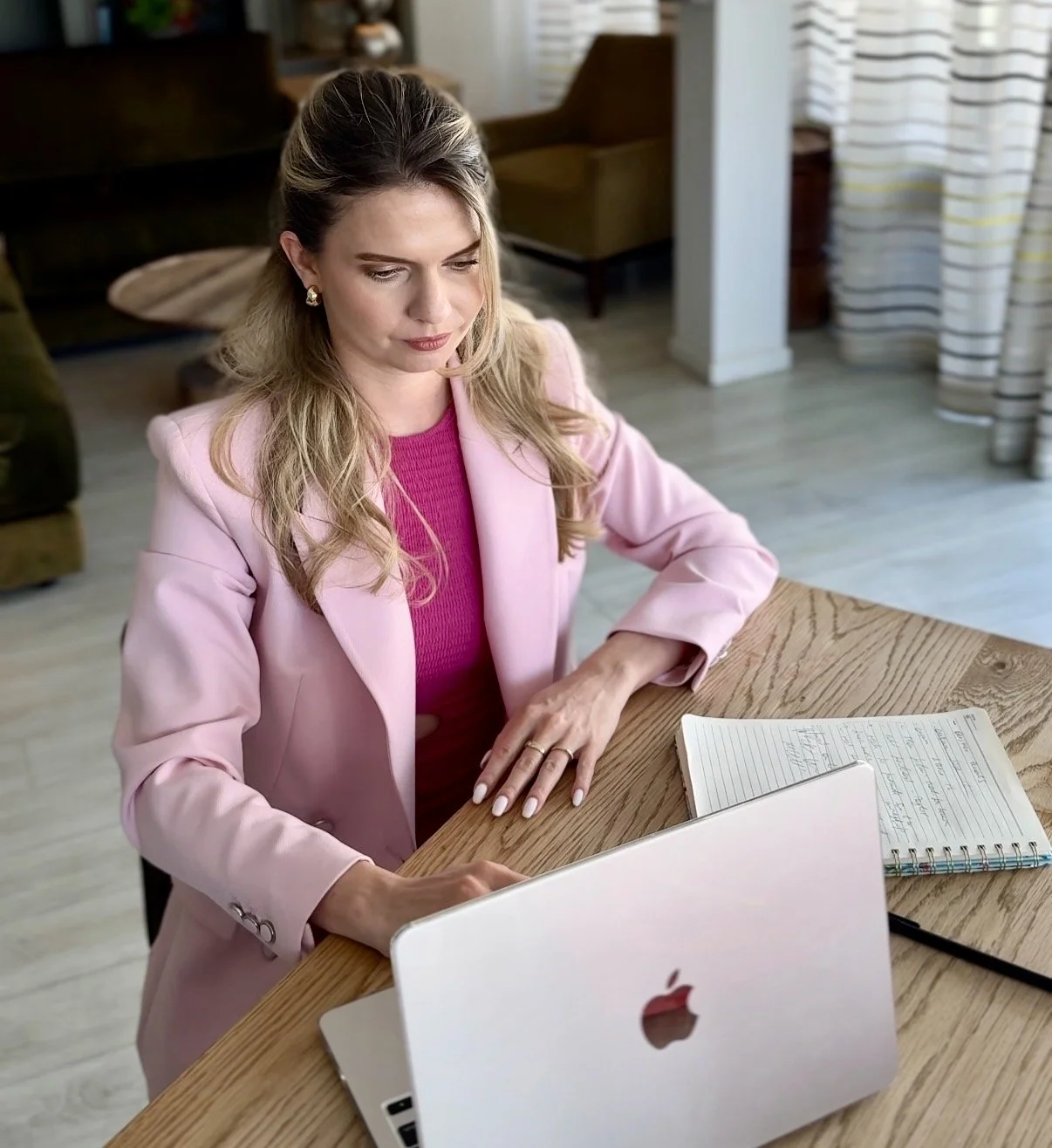
Presence coach Kate Ziuz during a one-on-one coaching session
What the Authority-Presence Mismatch Actually Is
Your authority is real. It's built from years of experience, results, expertise, and proof. It exists whether or not anyone can see it.
Your presence is what people actually perceive — before you speak, while you speak, and after you've left the room or the screen. It's physical. It's visible. And it's often sending a completely different message than your credentials are.
When those two things are misaligned — when your authority is high but your perceived presence is low — people underestimate you. Not because they've assessed your work and found it lacking. Because your body, your camera setup, your pace, your posture, or your eye contact sent a signal before your expertise had a chance to speak.
This is not a confidence problem. It's a mechanics problem. And the mechanics are fixable.
The Signs Your Presence Is Undermining Your Expertise
Most women don't know this is happening. That's what makes it so costly. You can't fix a pattern you can't see — and these patterns are invisible from the inside.
Here's what I watch for:
On camera: When I review someone's podcast recording or video content, I'm not listening to the words first. I'm watching what the body does before the words start. Shoulders that round forward the moment the record button is pressed. Eyes that scan the screen instead of landing in the lens. A pace of speech that speeds up under pressure. Hands that disappear below frame or fidget constantly. A voice that trails at the end of sentences, turning statements into questions.
None of these are intentional. They're what a body does when it registers pressure — and a camera, a microphone, and a blinking recording indicator are all pressure cues your nervous system picks up on before your brain has a chance to intervene.
On stage: The compression pattern. Shoulders folding forward, chin dropping slightly, body angling away from the audience. Often paired with speech that starts strong and then loses volume and authority as the sentence progresses. Sometimes a rocking motion — weight shifting from foot to foot — that signals anxiety to every person watching, even if they couldn't name what they're seeing.
In networking and high-stakes rooms: Eyes that don't land. A handshake that's too brief or too apologetic. Positioning in a room that's too peripheral — standing near walls, angling toward exits, taking up as little space as possible. These patterns communicate "I'm not sure I should be here" long before you've introduced yourself.
On video content: Energy that's slightly flat. The version of you that shows up on camera is a compressed version of the version in the room — what reads as natural in person reads as low-energy on screen. Adjusting for that compression is a skill, and without it, the warmth and authority you feel doesn't translate.
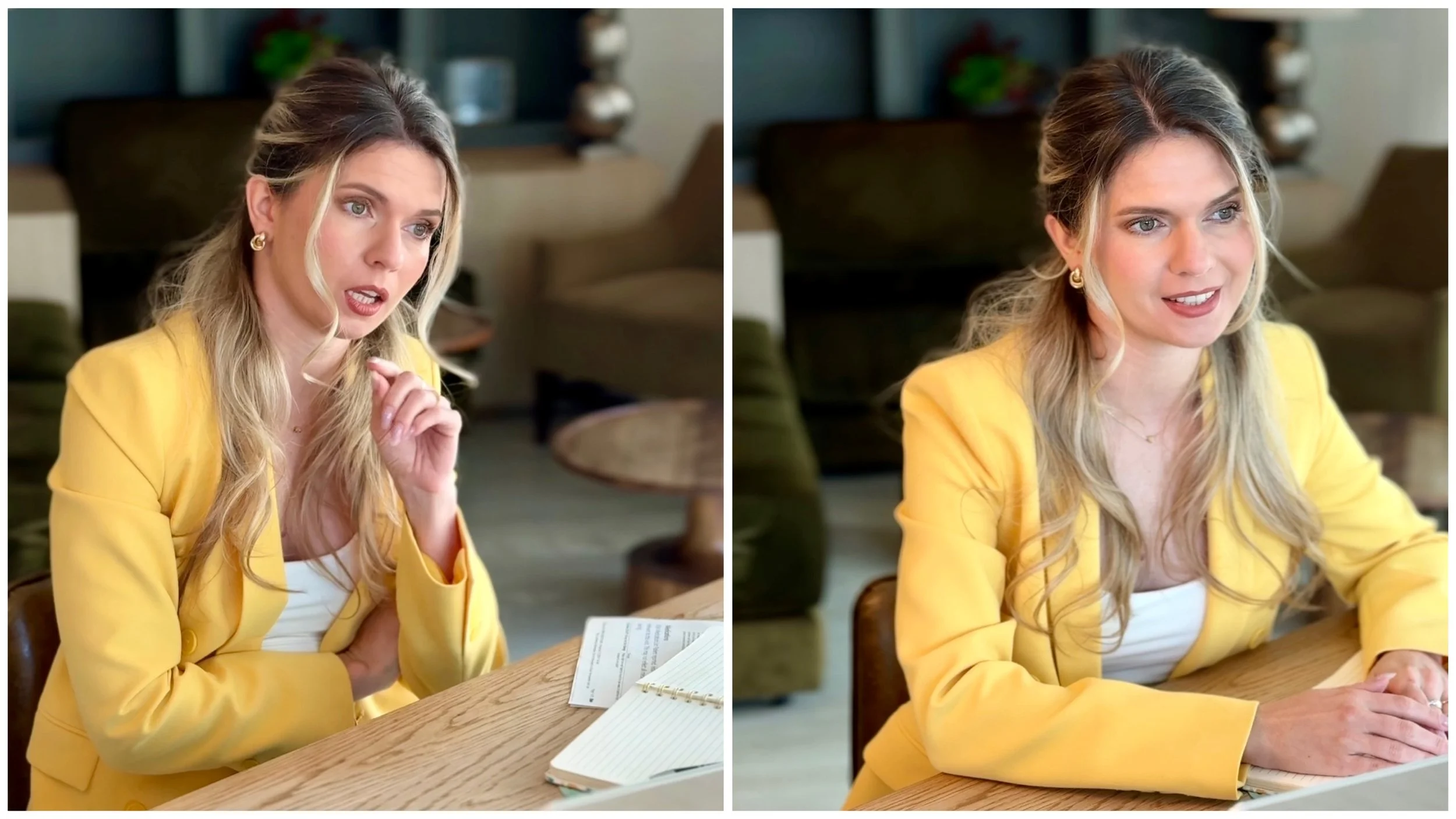
The physical difference between presence that undermines authority and presence that commands it. Illustrated by presence coach Kate Ziuz.
Why This Happens to Accomplished Women Specifically
Here's the part that matters: the authority-presence mismatch is more common in high-achieving women than in anyone else. Not because accomplished women lack confidence — but because they've spent years in environments that, consciously or not, sent signals that taking up space wasn't always welcome.
The compression pattern I see most often — shoulders forward, chin down, voice trailing — isn't random. It's a learned physical response to years of navigating rooms where making yourself smaller felt safer, more strategic, or more socially acceptable. It's not weakness. It's adaptation.
The problem is that adaptation follows you onto the stage and into the camera frame. It shows up in your podcast recordings and your networking moments and your speaking engagements. And it undermines the expertise you've spent years building.
The good news: adapted patterns can be interrupted. And replaced. And over time, overwritten entirely.
What Fixing It Actually Looks Like
I work in three phases with every client.
Phase 1 — Identify the patterns. We audit their current presence across the contexts that matter to them: camera, stage, networking, content creation. Most clients have their first "I had no idea I was doing that" moment here. That moment is where the real work begins — because you can't interrupt a pattern you can't see.
Phase 2 — Break the patterns. I teach the physical mechanics that replace what's not working: how to position your shoulders so your chest stays open and your voice has room. Where to place your eyes on camera to create actual eye contact. How to use pauses in a way that signals certainty rather than hesitation. How to stand on a stage so stillness reads as authority instead of stiffness. These are specific, trainable, repeatable adjustments — not motivational advice.
Phase 3 — Rewrite the patterns. We practice across multiple contexts until the new mechanics become automatic. This is the phase most people skip — and it's the phase that determines whether the work sticks. One coaching session creates awareness. Repetition creates a new default.
The Cost of Leaving the Gap Unfixed
Every visible moment you show up with a presence that doesn't match your expertise is a moment that either builds your authority or erodes it.
The podcast you recorded where you looked slightly uncertain — even if everything you said was correct and valuable — may be the reason they didn't book you back. The speaking gig where you held your content but lost the room energetically may be why the follow-up opportunities didn't materialize. The video content that didn't convert may not be a messaging problem at all. It may be a presence problem.
You can be the most qualified person in the room and still be the one they overlook. That's the injustice of the authority-presence mismatch — and it's the exact gap I exist to close.
How to Know If This Is You
Ask yourself honestly:
Do podcast hosts invite you back, or does each appearance feel like starting from zero? Does your video content reflect the authority you feel when you're in your zone? Do people in rooms respond to you the way they respond to someone with your level of expertise? When you watch your own recordings, does the person on screen match the person you know yourself to be?
If there's a gap between any of those — between what you know and what people perceive — that gap is costing you clients, credibility, and momentum.
It's also fixable. Faster than you'd expect.
If You're Ready to Close the Gap
The fastest way to know what's actually happening in your presence — and what to do about it — is a 30-minute strategy call. We'll talk about what you're building, what visible moments are coming up, and exactly where the mismatch is showing up.

Kate Ziuz is a presence coach for founders and entrepreneurs building visible brands. She specializes in the mechanics of on-camera presence, stage presence, and high-stakes preparation — helping clients close the gap between their actual expertise and how credible they appear. Based in Los Angeles. Featured in Best Holistic Life Magazine, Femforce Podcast, Authority Magazine, and more.
