By Kate Ziuz | Presence & Body Language Coach in LA
I'll say the thing most people in my world are too polite to say out loud.
When I land on a website full of AI-generated headshots, AI-generated flyers, and AI-generated hero images, I stop taking the business seriously. I scroll past. And I'm not the only one — more people do this than will ever admit it.
This isn't an anti-AI position. I use it daily, to draft, to brainstorm, to mock up an example image. That's a tool, and tools are useful.
What I'm talking about is different: generating a fake version of you. Your face. Your photos. Your voice. The thing your entire brand is supposedly built on.
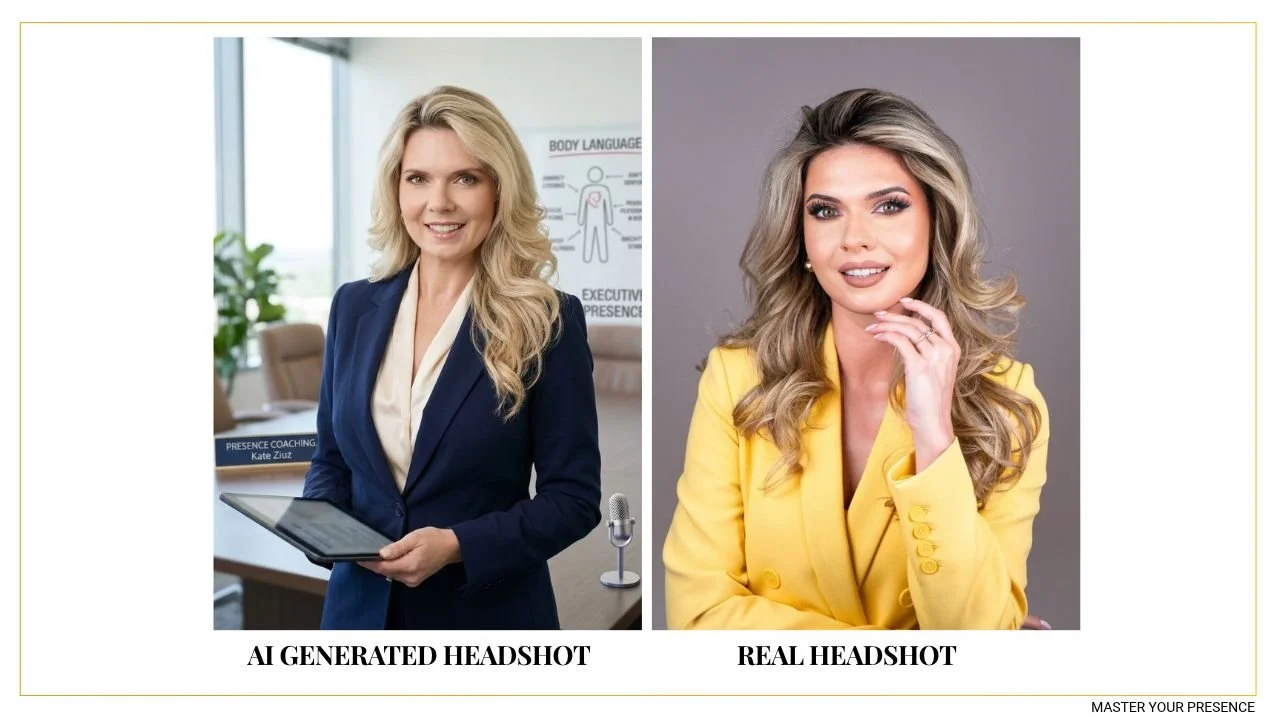
What an AI Headshot Actually Communicates
I generated an AI business photo of myself to test this. Both versions are above.
Here's the strange part: the AI version isn't bad. At a glance it's fine. But look for three seconds and something is off. The proportions sit slightly wrong. The lighting is too perfect in a way real light never is. The expression is almost human.
And then the damning part: it looks like everyone else's AI photo. Same uncanny polish. Same soullessness. Completely interchangeable.
That's the problem in one line. You spent years building something nobody else could build, and then represented it with an image a machine could generate for anyone.
Your photo is your first impression — on your website, your LinkedIn, your speaker bio. The moment someone lands on a generated version of you, before they've read a single word, their gut registers something here isn't real. They may never consciously work out why. But they feel it. And in a trust business, that feeling is expensive.
I Asked a Brand Photographer. She Didn't Hesitate.
At Create & Cultivate this year there was a Hot Seat session with brand photographer Brit Perkins. I asked her directly: what's the number one thing that kills authority and trust in photos?
Her answer came back instantly. "AI images. Number one."
Her reasoning: nobody is going to trust a human brand built on AI photography, and it gets worse the more your work depends on real human contact. A med spa. A personal trainer. A coach. If people are going to let you into their body, their health, their business — and your own face on your site isn't even real — what exactly are they supposed to trust?
That's a woman who photographs brands for a living. She sees what converts and what repels. What repels, immediately, is the fake version of you.
And It Isn't Only Photographers Who Notice
Teri Day — fractional COO, 30 years in operations
"People are buying your expertise. There is no industry I can think of where anyone can easily find ten more of you. So going and seeing AI photos, what does that say about you, and what you believe about yourself? That you won't take the time to get good photos of yourself, to invest in yourself. Or even a lack of confidence in how you look. Because this is you, I am buying from you. I am buying your knowledge, your product, and I want to be able to see that and trust it. And AI is not something I trust, anybody who's ever used AI knows you cannot just blindly trust it. So immediately it makes me question everything. Your credibility comes from you and your lived experience. If the only way you can separate yourself is through AI, what do you actually have to offer me? AI is a tool to support what you already have. But if we don't trust ourselves enough to show up as who we are, who else is going to trust us?"
Alena Le Blanc — stylist, Le Blanc Label
"AI photos create a big disconnect. I understand the desire to create something quickly that you think looks professional, but when you use AI for your portraits, it often doesn't look like you, and people can tell. It all starts to look the same, and you don't stand out as an individual. As someone who works on photoshoots often, I also see how important it is for a founder to step into the camera, even if it's uncomfortable. It's important for your growth and for people to connect with you, not the perfectly altered version of you."
Meghan Fialkoff — founder, Modern Day Wife
"If I see people using ChatGPT to create invitations or images that are so obviously ChatGPT, I do think it's less professional. It seems like they don't have the know-how. I think it's important that you have a branding kit and you follow it. It's your image, and it's very obvious when you use ChatGPT, and I think it lowers the professionalism of the brand. It's fine to use in a proposal or something more internal, but for facing outward publicly, I just don't think it looks very professional."
Lucy Bedewi — messaging and branding specialist, My Write Hand Woman
"If I notice AI-generated photos and it's poorly done, usually it means I'm unfollowing the person. Maybe that's an extreme stance. I don't mind people using AI, but badly done AI says a lot about how they value their brand assets. As somebody who works in branding and copy and web, if it's not going to be done tastefully, and there are other options, I will almost always go with the human one."
Katie St. Peter — producer, KSP Productions
"When I see AI-generated images or content from a brand, I immediately feel distrust, and disconnected from the brand. Especially brands promoting services or products meant to be marketed to humans. It should be humans selling to humans. Humans communicating with humans. Humans bringing that emotive feeling to their consumers, and captured by humans. Anything other than that just feels like such a disconnect."
Six people. An operations expert, a stylist, an event founder, a copywriter, a producer, and a brand photographer answering live from a festival stage. Different industries, different vantage points, no shared script.
Same conclusion every time: the fake version of you doesn't build trust. It costs you trust you didn't know you were losing.
What AI Still Can't Do
Here's what gets missed in the rush to automate everything.
AI is genuinely good at output — the deck, the caption, the first draft, the thumbnail. All of it is now cheap and fast, which means none of it is where your edge lives anymore.
Your edge is what happens in the room. The way attention shifts when you walk in. Whether people lean toward you or tune you out in the first few seconds. That's presence, and it has been quietly shaping every opportunity you've ever been given, whether you noticed or not.
A generated likeness has none of that. It might resemble you, roughly. It will not land the way you land. So when you lead with the generated version, you're showing people the version of yourself with no presence in it at all — and competing on precisely the ground where AI already beats you.
The Founder Training Her Avatar
A founder told me recently that she's training an AI avatar to make her content videos. She's camera-shy. Unsure of herself on screen. So she's building a digital version of herself to post instead.
I understand the impulse completely. On-camera discomfort is real, and the avatar looks like a clean solution — no nerves, no bad takes, no cringing at the playback.
But here's what I asked her, and what I'd ask you:
What happens when the podcast invitation arrives? The speaking slot? The TV segment, in a real studio, with real lights and a real host?
Are you sending the avatar?
Because if you're building a visible brand, that invitation is coming. And when it does, the gap between the manufactured version of you and the real one — the one who has never trained a single mechanic — is going to be brutal.
You didn't solve the camera problem. You postponed it and made it bigger.
The avatar lets you avoid the exact skill your growing business is about to demand. And as Alena put it, stepping into the camera even when it's uncomfortable is the thing that actually grows you.
The Good News Nobody's Telling You
There's a version of "AI will replace you" that's actually the best thing you could hear.
AI only replaces what's replaceable. The generic. The interchangeable. The personality that could belong to anyone.
What it can't replace is a specific human being with a point of view and a way of carrying herself that people remember. It can generate a thousand polished faces. It cannot generate the one who makes a room go quiet, or the one a host wants back on the podcast, or the one a client trusts before she's finished her first sentence.
That gap isn't closing soon. It's the one real advantage you have left. Everyone else is busy manufacturing a shinier version of themselves — the smarter move runs the other direction. Get more real.
So the question was never what AI can do. It's whether you're building the thing it can't, or handing it away.
My Honest Advice
Use AI for what it's good at. Draft with it. Brainstorm with it. Let it mock up an idea.
But the human presence your business actually runs on — your face most of all — don't outsource that. Invest in it. Get the real photoshoot. Learn the mechanics so you stop being camera-shy. Build the presence that makes the real you magnetic, because that's the asset AI can't copy, and the one your audience is actually buying.
The brilliant women I watch generating AI portraits of themselves already have the thing. They just don't trust it yet.
Trust it. It's the only thing in your business that's genuinely yours.
Would you rather be perfectly generated, or unmistakably real?

If It's the Second
That's exactly what I build with founders — the real presence that makes you worth remembering, on camera, on stage, and in the room.
If you've got a visible moment coming up and you'd rather face it than generate your way around it, let's talk.
Kate Ziuz is a presence and body language coach in Los Angeles, working with women leaders, founders, and entrepreneurs building visible brands. She teaches the mechanics of presence — posture, eye contact, pace, gesture, and stillness — for speaking engagements, podcast interviews, on-camera content, and media appearances. Featured in Best Holistic Life Magazine, Authority Magazine, VoyageLA, and more.
